July 28, 2026
Canadian Wildfire Smoke Is Back: Why Your Allergies and Asthma Feel Worse This July
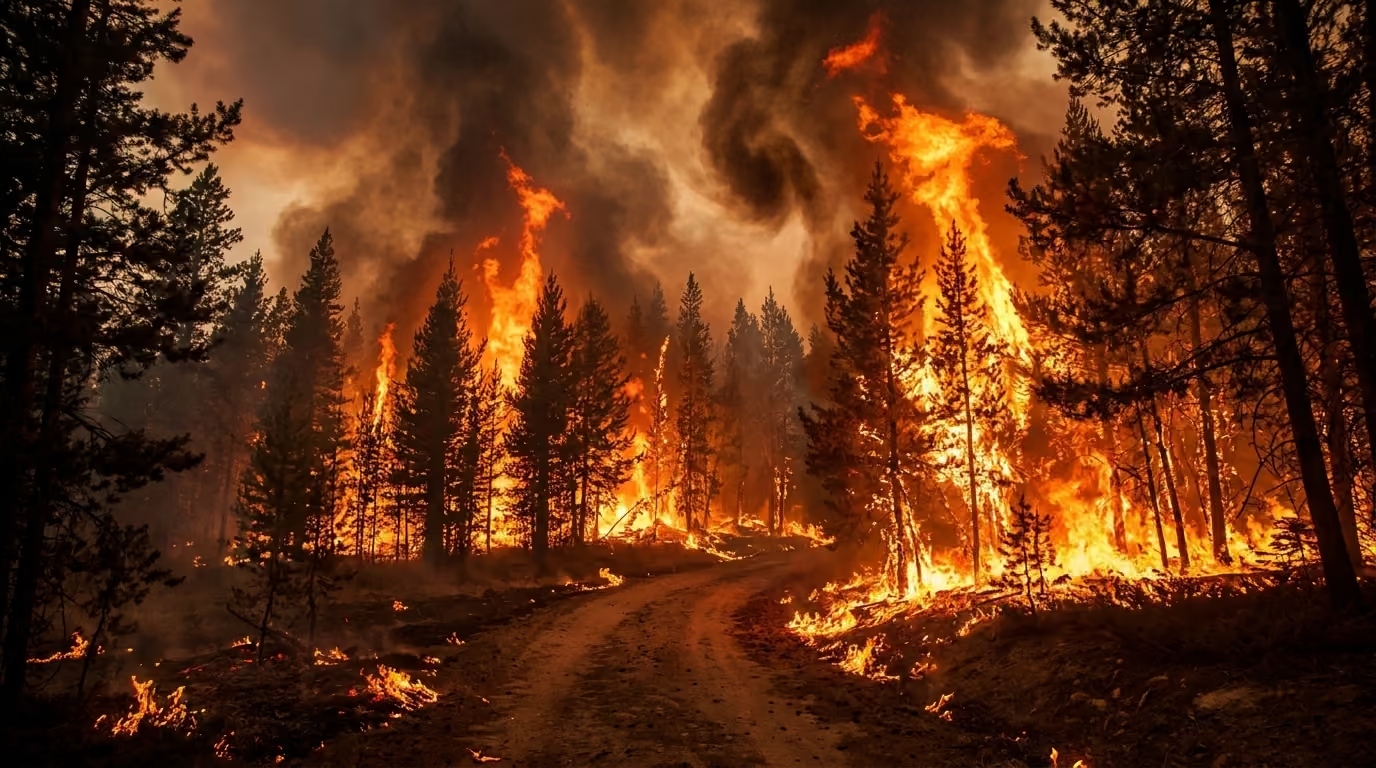
If your eyes have been burning, your chest feels tight, or your “mild” allergies suddenly feel like a sinus infection, it's not just in your head. Canadian wildfire smoke has been rolling across huge swaths of the U.S. this July, and it's doing more than turning the sky orange. It's actively making allergy and asthma symptoms worse for millions of people, including plenty of people who don't normally think of themselves as “smoke sensitive” at all.
What's Actually Happening This July
Wildfires broke out across Ontario in mid-July 2026 after a heat dome dried out the region, and the fires have since burned well over a million acres. Smoke from those fires has been riding the jet stream south, pushing air quality into “unhealthy” and even “hazardous” territory as far as the Great Lakes, the Midwest, and the Northeast corridor from Chicago and Detroit to Boston and Washington, D.C. Some monitors in the D.C. area hit fine particulate (PM2.5) levels near 200 micrograms per cubic meter, nearly six times the EPA's 24-hour health standard, triggering Code Purple alerts. This isn't a one-day haze, either. With the fires still active and the jet stream meandering, smoke has been drifting back over the same regions in waves for days at a stretch.
Why Smoke Hits Your Allergies So Much Harder Than Pollen Alone
Wildfire smoke's main ingredient, PM2.5, is a mix of ultra-fine particles and toxic gases small enough to slip past your nose's natural filters and reach deep into your lungs. Research on wildfire smoke shows it doesn't just irritate your airways in the moment. It damages the protective lining of your airway epithelium and disrupts how your immune system regulates itself, which is part of why smoke exposure is linked to flare-ups of asthma, allergic rhinitis, and even skin conditions like eczema. Some of the compounds in smoke, like polycyclic aromatic hydrocarbons, have even been shown to interfere with the regulatory T cells that normally keep allergic responses in check, which can make an already-sensitized immune system react more strongly to allergens it was already primed for, like pollen.
In other words, smoke doesn't just add its own irritation on top of your allergies. It can turn the dial up on how your body responds to everything else in the air at the same time.
The Timing Problem: Smoke Season Meets Ragweed Season
The worst part of this timing is that wildfire smoke exposure in July is arriving right before ragweed, one of the most potent late-summer allergens, typically kicks into gear in mid-to-late August. For anyone with a ragweed sensitivity, a summer that starts with smoke-inflamed, more reactive airways and then rolls straight into peak ragweed season is a rough combination. Add outdoor mold, which also builds through the summer, and you get several irritants stacking on top of each other instead of hitting one at a time.
Medication vs. Immunotherapy: What Actually Changes During a Smoke Event
Antihistamines, nasal sprays, and inhalers are genuinely useful during an active smoke event. They calm symptoms in the moment and are worth having on hand any time an air quality alert is in effect. But they don't change how reactive your immune system is to the allergens you're also breathing in alongside the smoke, so the same triggers keep setting you off once the smoke clears.
Sublingual immunotherapy takes a different approach. SLIT gradually retrains the immune system to be less reactive to specific allergens over time, so the underlying sensitivity, whether it's ragweed, grass, dust mites, or other common triggers, is smaller to begin with. That won't stop wildfire smoke from being irritating on a bad air quality day, but people already on allergy drops tend to have less allergic “fuel” for smoke exposure to inflame in the first place.
What To Do During a Smoke Event
On days with air quality alerts, keep windows closed, run a HEPA air purifier if you have one, and check your local AQI before spending extended time outside, especially if you have asthma or a known pollen or mold allergy. If you notice your typical allergy symptoms flaring up even on days when pollen counts are reported as low, wildfire smoke, not a new allergy, is often the explanation.
Is It Worth Addressing the Root Allergy Now?
If smoke season keeps exposing an allergy or asthma sensitivity you already have, treating the underlying trigger, rather than just riding out each smoke event, is worth considering. Identifying your specific allergens and exploring whether at-home immunotherapy fits your routine can mean fewer and milder flare-ups the next time smoke, pollen, or mold conditions overlap.
FAQ
Can wildfire smoke cause allergy symptoms even if I'm not allergic to smoke itself?
Yes. Smoke doesn't need to be an allergen on its own to make allergy symptoms worse. It irritates and inflames the airways and immune system in ways that amplify your existing sensitivities to pollen, mold, and other common triggers.
Is wildfire smoke worse for asthma than regular air pollution?
Research comparing the two suggests wildfire-specific PM2.5 is associated with a notably higher rate of respiratory hospitalizations than PM2.5 from typical urban pollution, likely because wildfire smoke carries a higher concentration of oxidative and inflammatory compounds.
Will allergy drops help during an active wildfire smoke event?
Immunotherapy is a gradual process that reduces sensitivity to specific allergens over months, not an acute treatment. During a smoke event, antihistamines, inhalers, and limiting outdoor exposure are the right immediate tools. Immunotherapy's value is in shrinking the underlying allergic reactivity that smoke events tend to inflame.
References
NASA Scientific Visualization Studio. Long-range Transport of 2026 Canadian Wildfire Smoke into the United States.
CNN. Thursday poor air quality and smoke in US, 2026.
Yale Climate Connections. Dangerous and historic wildfire smoke pollution event engulfs the U.S. and Canada, 2026.
Poole JA, Nadeau KC. The Effect of Wildfires on Asthma and Allergies. J Allergy Clin Immunol Pract, 2025.
Journal of Allergy and Clinical Immunology. Increasing wildfire smoke from the climate crisis: Impacts on asthma and allergies, 2023.
PMC. Wildfires and Atopic Diseases: A Review.
PMC. Clearing the Air: Understanding the Impact of Wildfire Smoke on Asthma and COPD.